
Rebar Corrosion in Phuket's Coastal Villas and Resorts: Causes, Crack Patterns and Prevention
Why inadequate concrete cover and missing spacer blocks cause rapid reinforcement corrosion and concrete spalling in Phuket's beachfront buildings — and how proper site supervision prevents it.
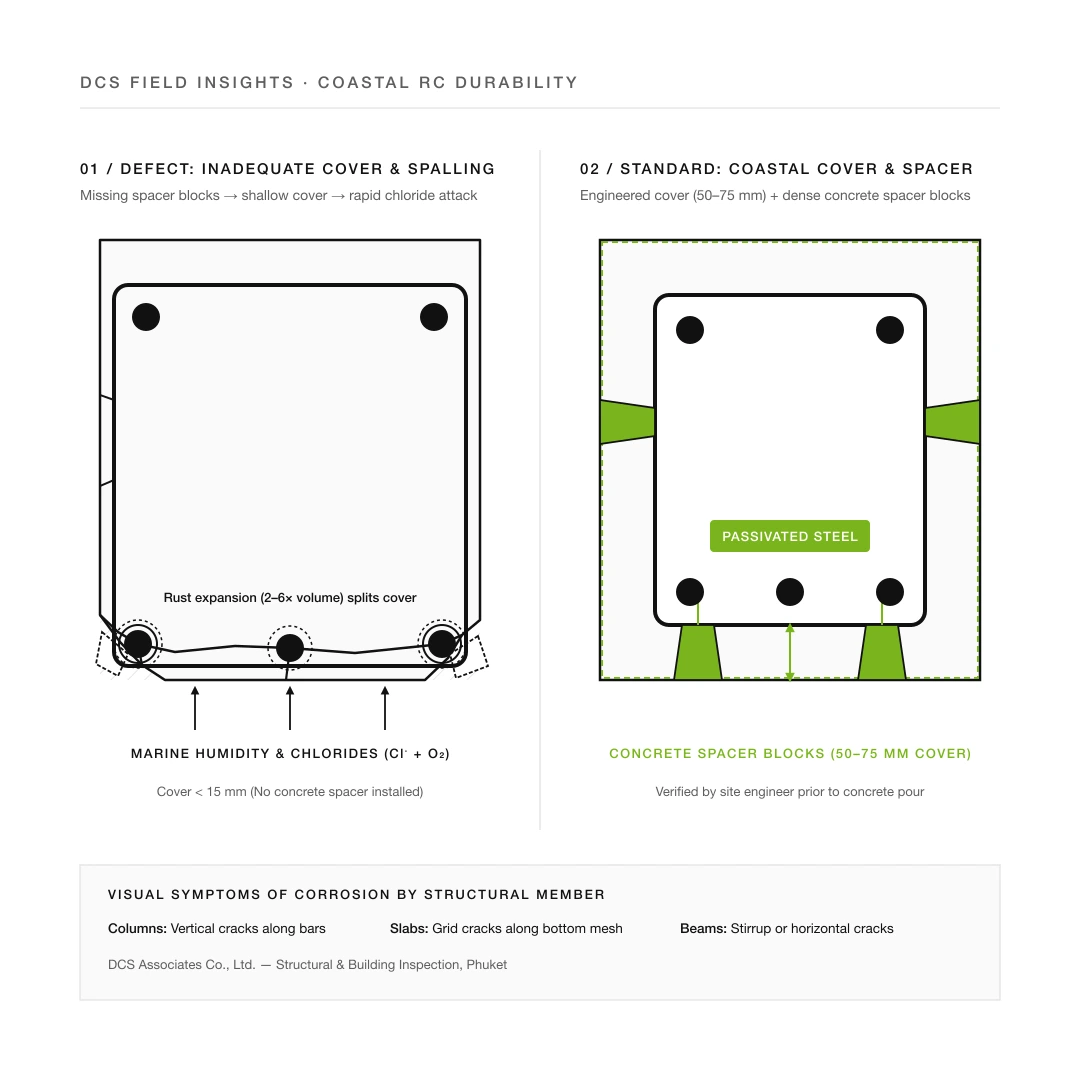
From decades of conducting structural inspections across Phuket — particularly for luxury hillside villas, beachfront resorts and five-star hotels — the single most frequent defect our engineers encounter is premature corrosion of steel reinforcement (rebar) in reinforced concrete structures.
Because many high-end properties in Phuket sit directly on headlands or along the coast, they are constantly exposed to warm, salt-laden marine air and high tropical humidity. When reinforcement begins to rust, the corroding steel expands to several times its original volume. This internal pressure pushes outward against the surrounding concrete until the surface cracks, delaminates and eventually spalls away.
How to Recognise Rebar Corrosion by Crack Pattern
In almost every coastal inspection we perform, the concrete cracking directly traces the layout of the steel reinforcement inside the member:
- Reinforced concrete columns: Cracks appear as distinct vertical lines running parallel to the main longitudinal column bars, often starting near the corners where chloride penetration occurs from two faces simultaneously.
- Concrete floor and roof slabs: Cracks form along the underside of the slab following the grid pattern of the bottom reinforcement mesh, frequently accompanied by rust staining or hollow-sounding delamination when tapped.
- Reinforced concrete beams: In the early stages, short vertical or transverse cracks appear at regular intervals matching the stirrups (shear links), which sit closest to the outer surface. In more advanced cases, continuous horizontal cracks develop along the bottom edge of the beam following the main tension bars.
The True Root Cause: Construction Quality, Not Design
When building owners see severe spalling on a villa or resort that is only a few years old, they often assume the structural design was at fault. In practice, structural drawings and engineering specifications almost always specify the required concrete cover — the protective layer of concrete separating the steel reinforcement from the outside environment.
However, during our intrusive inspections and cover-meter surveys, we repeatedly find that the actual concrete cover on site falls far short of the specification. In many cases, the steel stirrups or main bars sit nearly flush against the outer concrete surface.
This happens for two primary reasons on site:
- Missing or inadequate spacer blocks (ลูกปูน): When reinforcement cages are tied and placed into formwork without proper dense concrete spacer blocks — or when workers step on slab steel during concrete placement without re-supporting it — the steel rests directly against the timber or steel formwork.
- Lack of qualified site supervision: When contractors leave reinforcement placement and concrete pouring to unsupervised labour without a dedicated site engineer inspecting the formwork and cover depth prior to casting, these hidden defects are sealed into the structure from day one.
Once a building with shallow concrete cover is exposed to Phuket’s marine humidity and airborne chlorides, moisture and salt ions reach the steel in a fraction of the intended design life. The alkaline passivating layer around the steel breaks down rapidly, accelerating corrosion and significantly shortening the service life of the structure.
Remediation and Long-Term Prevention
Protecting a coastal building in Phuket — whether you are planning a new development, acquiring an existing property, or maintaining an operating resort — requires engineering discipline both on paper and on site:
- Engage an independent site supervision engineer: Structural drawings alone cannot guarantee durability. Every reinforcement cage, concrete spacer block, bar spacing and formwork alignment must be inspected and signed off by a qualified engineer before concrete is poured.
- Select experienced, quality-focused contractors: Work with builders who understand coastal concrete practices, including the use of dense, low-permeability concrete mixes, properly cured concrete spacer blocks of matching strength, and strict vibration and curing procedures.
- Specify coastal-grade concrete cover: For structures exposed to airborne sea salts in Phuket, concrete cover and cementitious mix design must be specified for marine exposure rather than standard inland conditions.
- Repair corroded members systematically: When spalling has already occurred, cosmetic patching with ordinary mortar will fail within months. Proper structural repair requires breaking out sound concrete behind the corroded bars, mechanically cleaning or replacing steel that has lost significant cross-section, applying an anti-corrosion zinc-rich primer and bonding bridge, and reinstating the section with a high-strength, shrinkage-compensated repair mortar.
- Commission a pre-purchase or periodic building inspection: Identifying cover defects, hairline corrosion cracks and moisture ingress early allows targeted remediation before structural capacity is compromised.